The wonderful thing about Tiggers
Episode 10Justin Dickinson
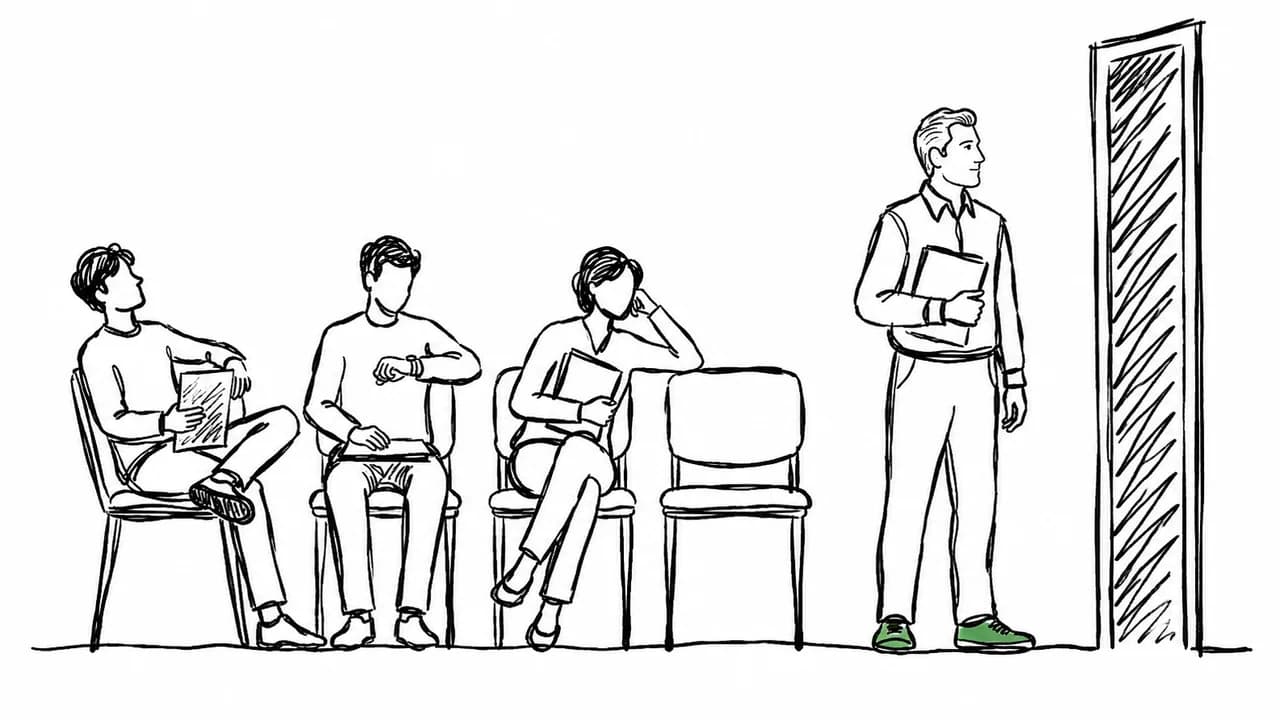
Justin Dickinson has hired product designers, and is now job hunting himself in a market that tightened while he was away. He explains what made a candidate stand out to him as a hiring manager, why being specific beats presenting your whole career, and how he keeps his head straight when applications go quiet.
Key takeaways
- Treat the hiring manager as the user and do the empathy work designers already do: ask what problem they are facing right now, and answer that.
- Give the hiring manager a sound bite they can carry to whoever has to approve the hire, because every role had to be justified to somebody.
- Read your own portfolio the way a stranger skimming it would, which is how he discovered he read as a branding designer: two of his first five entries had the word rebrand in them.
- Treat yourself the way you would treat a friend, because it is far easier to write a recommendation for someone else than a cover letter for yourself.
- Find the thing that makes you one of one, and every time you catch yourself saying you cannot, name one thing you do have, different each time.
Chapters
Justin’s career journey and finding your edge
The wonderful thing about Tiggers is Tiggers are wonderful things. Find the thing that makes you one of one. Everybody is unique. There are no two designers who are exactly the same. Really spend some time and introspection on what makes you different.
Justin Dickinson, welcome to the JobQuest podcast.
Thanks for having me. I’m excited to be here.
This is the tenth episode in the first season of the JobQuest podcast, and I’ve had the chance to speak to career coaches, to recruiters, to job seekers, and I’ve learned a lot about the job search and the hero’s journey of the job search, as we like to think of it at JobQuest. So a quick thank you to all the guests who’ve been on the show, and to everybody who’s been listening. If you’re just coming to this on episode 10, I encourage you to go back and listen to previous episodes.
And I also want to thank our founder Derek Kang, whose vision all of this is. He came up with this great resume tool called JobQuest. It’s a really helpful tool, I’ve used it myself with shaping my own resume, and he wanted to hear what folks had to say who are actually on the job search and involved in the job search in various ways. So that’s the reason for this podcast. It’s been a privilege to host it, and I’m once again privileged to be speaking with you today.
It’s a privilege to be episode 10. Hopefully it’s a grand finale.
I hope so. Yeah, I think it will be. So let’s jump in. As I mentioned, JobQuest sees the job search as a hero’s journey. You’re literally on a quest to find the role of your life, or to build the career of your life. Literally. So why don’t we kick it off by you telling us a bit about your own career journey so far?
Sounds great. I love that metaphor too, of the hero’s journey on the quest. It immediately made me think about an RPG, and I’m like, what do I have in my inventory?
And I think throughout my career I’ve tried to keep a really wide array of potions and spells and armor and things like that. Starting out, I did both front-end coding and design. I’m old enough that it was back in the days of Flash websites and designers really doing their own HTML and CSS, so that was a really great place to start. And then I had the chance to move more specifically into product design as the roles matured and the expectations were more solidified, and then started doing management, which is where I really found my love and my place. It was really great to do the sort of player-coach role of design manager and design contributor. I found that I was much more motivated to help the team achieve their goals than I ever was for myself, because I could see their success and it inspired me to do even more.
Yeah.
And then just moving from company to company, trying to find two-sided markets, trying to find really mission-driven places. I’ve gotten to work at Vimeo with filmmakers. I’ve gotten to work at Namely with HR software, and people who are suffering through figuring out their taxes and their health insurance and their end of quarter performance reviews, all these really stressful points of interaction, and try to bring some levity.
And then most recently at TPT, which a lot of people don’t know about. It’s like the Etsy for teachers, so it’s a place where teachers can buy and sell lesson plans and material for the classroom. And I came in there February 2020, where they were just starting to move to a more hybrid classroom, which timing couldn’t have been more auspicious. Unfortunately.
Yeah.
But that was really interesting, because I helped them launch a new digital product that’s kind of like Google Docs for teachers, called Easel, and transform the company with a rebrand and a restructure. It’s been really fun to do all of that, and then I took some time off to focus on other interests.
I had felt sort of not burnt out, but a little bit. If we’re using that metaphor, I was just kind of grinding the quests, out there farming. I was like, what’s something I’m passionate about that I could get back into? So that allowed me to write more and get back much more into meditation and the self-help type stuff that I’m really interested in, before reapproaching the job search. And the job search has been tough, so I’m glad I had that preparation going in.
Yeah, for sure. Well, it sounds like it was a good, maybe well needed reset. And I think a lot of people did something similar in that pandemic time, or in the past few years, right?
I’m a big Marvel fan, and I think if I had to pick which of the Avengers I was, it would be Nick Fury. I’m always sort of conviction in the vision, and then figuring out how to assemble the right team. That’s where I see myself. Plus, who doesn’t want to be Samuel L. Jackson?
Yeah, 100%. So I want to hear about your job search and what you’ve learned and lessons that you can share about that. But before we get into that, you mentioned being in leadership roles in the past that involved hiring. So what did you learn about the job search from being on that hiring side of things?
That was actually really fascinating. I once gave a talk at South by Southwest called Your Portfolio Is Garbage, and it was trying to help designers understand how to present themselves better, because I was always really amazed at how I would go through a designer’s whole portfolio and application and at the end be like, I have no better understanding of who this person is than when I started.
And I think that’s really common as a designer. We hear a lot about storytelling and telling your story, but this isn’t a biopic about your entire career. You have to put yourself in the role like you do with users. You put yourself in the user role: what is this person doing uploading a video? What is this person doing? It’s 10 minutes before class and they need a quiz about geography. Put yourself in the hiring manager role. They’re looking at dozens, if not a hundred candidates.
And how do you stand out? How do you tell your story in such a tight summary that the person doesn’t get lost? The way I always look at it is, every job position had to get approved. So as a hiring manager, I always had to go to the CEO or the head of product or whoever and say, we need a person to do X, Y, Z. And as a designer, if you can figure out what you’re really good at, and even if you can through research in your application, what might that X, Y, Z be? Where is this company in their growth? What does the job description say? What can you read between the lines and figure out?
How to stand out to hiring managers
If, rather than presenting your entire life as a designer, you can say, here’s how I can help you solve X, Y and Z, that will cut through so much of the other noise and be a signal.
And at the same time, I find this is true in general: if you can provide the sound bite that the person you’re handing it to can use. If you can say to the hiring manager, I have scaled teams in a new product of ambiguity while also acting as a player coach, and that’s what they’re needing to hire, they can just pluck that quote out of the interview and bring it right to the people that are justifying the hire. So simplify the job of the hiring manager, both in how clearly you present yourself and in how you show that you are the answer to the problem.
And if you don’t know the answer, the first thing I would do in an interview, and the people that have been the most impressive do this, is say, what problem are you facing right now? Because that’s what a designer does, right? Day one on the job you’re going to say, okay, what’s the user problem that we’re trying to solve? So it’s almost like, treat the hiring manager, treat the job, treat this company like the end user. Get inside their head, do that user empathy work that designers do, and make them your user, and figure out what do they need and how can I provide a solution to that. I find that makes you stand out a lot more.
Yeah, I like that question a lot. What’s the problem that you’re facing right now? And then you’re going to know what to focus on and what to hone in on.
And I like that because advice that I hear a lot, and I think is very good but doesn’t necessarily fall into application, is specificity. Who are you as a designer? What is your specific experience? I think that’s really good. But compare that specificity with here’s why that specificity solves your problem.
And that might sound arrogant. I hope it doesn’t, because as a hiring manager it’s tough to go into a brand new thing. You’re so inundated with resumes and cover letters and portfolios, and you’re looking at 15 pictures of whiteboards that someone uploaded and you’re like, I don’t really understand the story you’re telling. But if somebody comes in and is like, this is how I solve the problem, this is how I do it, that makes it easier for me as the hiring manager to be like, wow, this person really stands out.
Yeah. And especially if it’s tailored. It’s making me think of, JobQuest is a tool that helps people tailor their resumes to particular jobs, so that you’re not just sending in your blanket resume. And there are a couple of schools of thought. Some people say just have one good resume and send that to every job. But JobQuest is designed to really help you tailor, so that you can help somebody figure out why you’re actually a good fit for the role just by looking at your resume.
It sounds like you’re saying with this idea of, your portfolio is garbage. Is that the name of the talk?
Yeah.
That’s kind of the idea. If it’s just this general here’s everything that I’ve done, and I’m looking to solve specific problems, it’s very hard for me to figure out. I have to do a lot of work to figure out how that applies to my situation.
It’s tough. And if you present this huge product, the one thing I’m thinking is, well, what did you do, and what was the team? Because I’m trying to suss out the rockstar, the egotist. You’re going to be on a team. You’re going to have other designers, you’re going to have engineers, you’re going to have PMs, you’re going to have researchers, you’re going to have user research. Tell me how you worked across all of these interaction points, because that helps me picture you in the role. If I want to make an offer, I want to be able to say, I have a good sense of how this person’s going to exist in the ecosystem that we have.
But yeah, I think tools that help you customize your resume, and especially cover letters, can be a great thing for that. I sort of hated cover letters early in my career because they felt so rote, and I was just like, I’m excited about this opportunity, I would love the chance to design. But now I see it differently. If you can use a tool to help you better read through and suss out what’s the problem, what are they trying to solve, and then tailor your experience, now I’m speaking to you about how I can actually help.
Exactly.
And I think the more specific the better. A person is distracted. They’re looking at a lot. It’s a lot to ask them to read this thousand-word case study. They’re going to skim it, they’re going to look at the pictures, they’re going to try to scan for words they’re looking for. The better it’s like a newspaper: write the important stuff up the top, and then they can stop reading at any point and cut off the rest.
So you told me a bit about your experience on the hiring side of things. Let’s talk about the other side of the coin. Tell me about how your job search has been going, and what’s been the story of that job search.
It’s been hard. I’ll admit, it’s a tough market. I’ve been blessed in my career that almost all of my jobs, the next one shows up when the previous one is coming to an end, either through networking or through managers. I’ve had a lot of really great managers who go out of their way to help everybody on the team find a new job. I’ve worked for a lot of startups who closed down, so it’s sort of a mass exodus, and that was the case. My first startup here was a personal finance startup, a joint effort with Dow Jones and IA, and my manager there helped me find the Vimeo job, which was really amazing. And if you’re a manager, do that if you can.
But this one, I think it was the combination of, it was another mass exodus from the company. They got acquired and a lot of people left, and I really wanted to take the opportunity to take a break. And I think coming back in, it was just enough time off that the job market changed. It got much tighter. People were less likely to just hire and figure it out. They’re really looking for that exact, not unicorn, but the key for the lock that’ll open whatever opportunity they need.
So it’s been tough. And I also think that with all of the new screening systems, it can often feel like you’re shouting into a void. You don’t get a lot of feedback. You don’t even know if the person at the company who you might be able to connect with sees you. There’s AI screens, there’s HR gates, there’s all kinds of stuff. And one of the hardest things, I think, is when you spend a whole day applying to a million jobs and then just silence. I think you start getting imposter syndrome. You’re like, am I bad? Have my skills eroded? Am I doing something wrong? But you also just don’t know. You’re like, maybe nobody saw this. Maybe the robots just decided that today was not your day. So it’s been a tough search.
But I think the flip side of that goes almost back to what I was saying originally, and I think it’s specificity. You can’t get by, like you said, with just one resume to rule them all. Here’s my resume, here’s my generic cover letter, to whom it may concern. You really have to cut out enough time to be thoughtful and understand your own skills as they apply to different jobs.
Tailoring your story in a tough job market
And really try to look at each job application as, where are they in their growth cycle? What do they need? As the player-coach, mid-size company person, I’ve often come in at a company when they’re in a moment of growth. Others come in around 30 or 40 people and then leave at 200. You’ve got to figure out where that company is and how to articulate yourself to them, and then just take whatever feedback you can.
It was very humbling. I got feedback from a hiring manager when I asked, what did you think of my portfolio? And they’re like, oh, it seems like there’s a lot of branding work. And that was crazy to me, because I think only in my last job did I have a significant amount of brand work. But when I looked at my portfolio, two of the first five entries had the word rebrand in them.
So as much as that represented a small fraction of my actual experience, to someone coming in cold and just glancing at my portfolio it’s, oh, the guy does branding, we don’t really need that. So you have to rethink, almost look at your portfolio like a hiring manager. What’s the first thing you see? What are the words you see? What sort of keywords pop out?
And if you’ve been doing this for a long time, you have a big portfolio, and it’s a lot to ask everybody to look at everything. So something I’ve been doing is putting together custom PDFs that outline and articulate the answers to those questions as I see them, then link out to specific case studies rather than just saying, here’s a link, go nuts. It’s a little bit more control. You can kind of guide the narrative of how people will see you.
Mhm.
And then last is, it’s really lonely to search for jobs. I think if you’re like me, you can kind of get into a loop of negative self-talk where you get those we will not be moving forward emails and you’re like, well, all right, I’m just going to watch TV for the rest of the day and start again tomorrow. But I started doing twice weekly standups with friends who are also looking, and just sharing here’s what I’ve done, here’s what I’ve updated, here’s what I’ve applied to, and helping keep each other honest and keep each other on board. Provide feedback. What does this look like? Look at my portfolio, what do you see?
Yeah.
These are the roles that I’m applying for, what do you think? Doing that kind of thing. Anything to keep yourself in a positive headspace.
Are you setting metrics with that group, like this is my target number of applications? Or are you more focusing on quality and trying to make networking connections?
Well, we’re mostly designers, so I think it’s qualitative more than quantitative. That’s what we’re drawn to. But we try to keep a PM in there to keep us focused. Mine is, I have a Google folder with all my cover letters, and figuring out what works, what doesn’t. And a friend of mine who just got hired at Duolingo actually has a whole sheet. He’s like, this many cover letters, this many applications, this many first rounds, this many final rounds, and it’s all these curves.
Yeah.
And I was like, that would make me suicidal if I had to look at the data of my job search. I respect you very much that you can do that. But for me it’s more like, am I applying to the same stuff?
And one of the things that I’ve lately really latched on to is, those days where I spend all day applying, I end up really excited at the end. There’s a lot of those jobs where I’m like, oh, this would be a really great opportunity. And rather than let that excitement sour into regret when you get the rejection, I hold on to that. I’m like, I am excited to work again. One of the reasons I took a break is because the idea of going immediately right back to work sounded awful, because I was just burnt out. So I’m trying to celebrate that I’m not burnt out, that I am excited, that when I see a description of a job of what they’re trying to solve, I’m like, oh, that would be so cool.
So that I’m trying to use, and trying to impart upon friends as well. And I think it’s also, somebody gets to a last final round and then they ghost and you don’t hear anything, and you want to be that person’s shoulder to support and be like, hey man, it wasn’t you. It’s a lot of the same advice I give to friends who run dating apps, which luckily that stage is behind me. But I’m like, you can’t feel rejection because this person didn’t know you. They knew a slice of you that you presented. We can optimize that, but you can’t take it personally because it wasn’t personal. They weren’t rejecting you, the person. They were rejecting you, the resume. Or the profile, in the dating app sense.
Yeah. And thinking about the hero’s journey metaphor, there are peaks and there are valleys in all of these journeys. If you’re in one of these valleys, where you’re looking for this job, you’re on this quest, you’re trying to find your way out, the one thing we know from the hero’s journey is it’s not easy to make your way out. Otherwise it wouldn’t be worth it when you get to the end. But it sounds like you’re having these moments of saying, I’m excited about the potential of this job, and I’m excited about this potential. And you’re seeing possible roads out of that valley, which is encouraging. And you only need one of these to work, right? You send out 25 job applications, you’re not going to get 25 jobs, you’re going to get one.
Mhm.
And I know from experience that once one works, you forget about all those other ones.
Mhm.
I couldn’t tell you, in previous moments of job search, the jobs I applied to and didn’t get. Maybe that’s just selective memory, but you remember the one you get, and that’s the one that you need.
Can you characterize the job market now as opposed to how you’ve seen it in the past?
I don’t know what the single word would be, but I think for the first time people are really zeroing in on finding the exact right fit, and that can be both a positive and a negative. One, as I said before, it forces you as the job searcher to be really clear with what you bring to the table. Sometimes it seems like people are wanting a multifaceted approach. They need somebody who can design a mobile app but also product packaging. They need somebody who can eventually grow a team, but the first six months just be an individual contributor. And I think because we’re no longer in the stage of, we’re going to hire five people in six months and figure it out, that has just forced everyone to be much more cautious in their design.
Which means I think as a job seeker you have to dial in even more closely to what I described before, what is the problem they’re trying to solve. That’s become much more of a needle to thread, of both discovering that problem and proving that you can do it. I think in a time like this it’s really hard to move into a new area, because people always want to see experience. So let’s say you’ve always really been interested in user research but you’ve never done it. That would be hard, to be like, I can offer user research, because they always say, well, show us where you’ve done it already. It’s that thing of, it’s hard to start something new because you need experience, but to get experience you need to have done it. It’s almost like a catch-22.
Why hiring has become so cautious
So I think it’s on the job searcher to be really good at articulating specificity. Think about the weird stuff you’ve done at jobs that maybe you didn’t even realize you did. Did you do a lot of copywriting, microcopy? I used to run copywriting workshops with my team, because that was one more thing they could offer. And if you can say, hey, you can hire me as a designer and also have experience A/B testing microcopy across the product to show conversion improvement, that’s another piece of data that hiring manager can go to and say, look, we can save money not hiring a copywriter, or not having to outsource this copywriting, because this person can do it. So define your expertise in little corners you might not have noticed. And then just patience, because everybody’s trying to hire the exact right person because they can’t afford attrition.
Yeah. But you get the sense that people are hiring now? It’s not a frozen market?
Maybe not as much. It’s hard. I don’t know, because at the same time I’ve been looking for so long and I’ll see a lot of the same jobs get reposted. So I don’t know where companies’ budgets are. I don’t know if things get paused. I would say maybe one third of the rejection letters I get are not, we’re not going to move forward. It’s, we are no longer hiring for this position.
One third. Wow.
Yeah. There’s probably a German word for this, but it’s when you get that sense that you’re the third person they interviewed just so they could say they interviewed three, but they were always going to hire internally, or they were always going to hire the first person. That’s a crappy feeling.
But I do think that companies are more timid than I’d ever seen them before. I used to write these quarterly plans for headcount and it was always a slog, but you usually got some of what you needed and you saw this growth. I think growth is tougher now, and there’s a lot more justification for hiring somebody than there once was.
I don’t know if it’s a response to the current job market or not. Or maybe it’s just people are looking in different directions, following their interests, whatever the case may be. It seems like a lot of folks are going in the direction of entrepreneurship, of consulting, of fractional leadership. Is that something you’ve explored or have an interest in?
It’s something I’m starting to explore. I’m really fascinated by its potential. Being again on the flip side, I’ve worked at places where we’ve hired temporary leadership or fractional leadership, especially for something that’s a time-boxed project. So if you’re going through a corporate rebrand, that doesn’t need to be a full-time hire. If you’re going through the launch of a new product and you need a really specific kind of engineer, that doesn’t necessarily need to be a full-time hire. I actually think it’s smart economically to consider a short-term fractional type thing, because you don’t always need the full-time.
That being said, I have also seen that there are a lot of places on the design side that are really going from that zero to one moment, where we’ve always worked with contractors, maybe overseas, maybe they weren’t really thought partners, they were more executors. The metaphor I always use is, if you go to a diner and order a grilled cheese, you have a really clear idea in mind of what that grilled cheese is and you just need somebody to make it for you. But if you go to a Michelin star restaurant, you’re sort of putting yourself in the hands of the chef and you’re willing to see their vision as it goes for food.
So when you’re going from one to the other, I think for a lot of companies it’s hard to know how to do that. If you’re a business founder or a product founder, maybe you’ve never really worked with designers. Is there an opportunity to bring someone in who almost holds your hand in how to build a design team? What kind of designer do you need to hire full-time? How do you work with them? What’s the process like? I’ve seen designers flame out at places, or burn out at places, because the PMs and the engineers don’t know what to ask for, or they don’t know how to best interact with design, how to partner with design as design thinking. It almost goes to a service design idea: how do you integrate design into an org that didn’t always have design from the beginning? I think that’s one fractional option.
So it’s something I would love to pursue. I think also at this stage in my career it would be really exciting to spend six, eight, twelve months on something and then move on. That didn’t used to appeal to me, I think because I started in agencies and you just never saw the iteration and the user value. That was more, you work on something six weeks, launch it and never look at it again. If you could work on something where you see some iteration, I almost think of it as getting to a small town and getting the plumbing set up, getting electricity set up, getting everybody up and running, and then you’re like, okay, I can move to the next.
And I would love to do that. The problem, like I said before, is it’s hard to get a job doing something you haven’t done yet. So even small things like, how do you market yourself as a fractional design leader? You can’t really respond to a job application and be like, actually, I think you shouldn’t hire me full-time, you should do this other thing.
Yeah.
How do you price it? What are the materials you use? All that day-to-day stuff. And I’m sure this is stuff you can figure out. I think this is where it’s nice where you need mentorship. Find someone who’s done this and say, how did you get started? What are your invoice systems like? What are your price models? How do you pitch yourself?
Yeah.
I think getting over that first hump of, I’ve never done this before, how do I do it, how do I show expertise, is a hard part of getting started in that. But it’s something that I’m looking through and approaching now, because I think there’s a lot of opportunity there in the current job market.
How AI is changing design careers
My perception, tell me if I’m wrong, is that designers might be a little bit immune to the AI job replacement threat compared with other folks. Is that true? Is that not?
It’s both true and not, on AI. And this is another reason why I’m really excited to find a design job: even in the two years since I was at TPT, AI design tools have exploded. I talk to friends who are IC designers, and while you still need the designer, I think what the designer’s day-to-day job looks like has completely changed. So while they might not be replaced with the AI, their day-to-day workflow is fundamentally different with the AI. You might not be spending a lot of time making really detailed Figma prototypes. You might be working with these AI tools and the engineers to throw together A/B/C tests on a really functional, scrappy prototype built with these AI tools.
So you’re more of a facilitator between all of it.
Yeah. And I think it changes your thought process, hopefully for the better. A lot of the time the tough part with design is, how high fidelity do you go with these proofs of concept before you test them, even internally? I think a lot of that can be done by how you run your design orgs, which is a whole other podcast. But I know it has changed. I don’t know exactly how, because it’s really hard to just be a guy looking for a job sitting at home. You can download the tools, you can buy the subscription and you can run through a scenario, but it’s never going to be the same as a real life product spec you get that you then have to use these AI tools with.
So, while not yet replaced, I’m sure they would like to be, right?
It yet again changes the design expectation, for that other metaphor of the grilled cheese versus the Michelin star. Maybe the designer is now more like the farmer at the farmers market who’s just providing the ingredients, and then those get fed into these tools to come up with different menu ideas.
Yeah, okay, that makes sense. That’s my view from the outside.
And again, that’s one of the things I’m most excited about. I think it’s really cool that the industry has changed so much, and I’m like, I want to jump back in and see what it’s like to actually day-to-day do it.
Let’s talk about the mental grind.
Oh, yeah.
How do you stay positive, stay focused, kind of keep your eye on those various possible roads out of the valley?
It’s tough. I’m a person prone to anxiety. So I think that it is not good for any of us, but specifically I know for me, to just sit alone in a room and type cover letters over and over and over all day. Even as much as I’ve moved more into the management side and the business optimization side, I am still at my core a creative person. And you can spend eight hours in a day applying to jobs, and that is not creative work. It is grueling self sales.
So I think there’s two things. One, like I said before, I always find it easier to help someone on my team or help a friend. So a small amount of dissociation as a treat can be nice, where sometimes I will act like professional designer Justin is not me, it’s a friend, and I’m promoting this friend. Because that makes it easier. I always think about how, when the people you love mess up, you have patience for them. You give them second chances. You see the best in them.
But it’s really hard to do that for yourself.
Yeah, totally. And if you can sort of dissociate, that’s probably a bad word, but if you can figure out how to treat yourself the way you treat a friend, both in defense of how important and wonderful they are, and in how you can promote them. It would be so much easier for me to write a recommendation for a friend than a cover letter for myself.
Yeah.
So if you can figure out the best way to step out of your own brain and look at yourself from the side, and treat yourself with that empathy and love that you’d give to a loved one.
And then the other side, I have to force myself to interject creative work with the job slog. A long time ago I had a blog about TV, and I would write cultural reviews, and I really got a lot out of that. I love watching TV and movies, and I find that I love it even more when I interact with it in a critical lens. So I’ve started doing that again. I actually started a blog, I don’t think anyone’s done that in 10 years, but writing about TV, writing about culture. I had always wanted to write fiction, so I started writing fiction. I wrote a short story. I’ve always wanted to write screenplays, and I have a friend who works in Hollywood as a screenwriter, and just hitting them up and being like, hey, what are five things I should know if I want to write a screenplay? If I ever wanted to get a job as a writer, how do I do that?
And just finding new areas. Something about that is helpful, because the job search is so uncomfortable in selling yourself, in constant rejection. There’s a certain discomfort in creativity, of trying a new thing, that is a better discomfort, because you can feel yourself getting better. The first time you write a screenplay you’re like, wow, I’m bad at this, I have no idea how to format it, I don’t know what’s going on. But then you do a little better, and you do a little better, and you revise and you revise, and you’re like, oh my god, this could be a TV show. And that discomfort, at least for a creative person, I think is much more familiar. So you temper the ways in which you’re uncomfortable with creative fulfillment and the slog of job search stuff, and just try to find that balance.
Yeah, I think balance is key. I like that advice to treat yourself like a friend, the way that you would treat a friend. That seems like a great strategy to not, like you said, take it so personally. Because each one of these rejections feels personal, but like you said, you don’t even know if it’s the AI tracking system that has rejected you, or if they had an internal candidate all along. You have no idea. And like you said, they don’t know the whole picture of you anyway. They’ve only seen this little slice.
And there’s a metaphor I heard once, that life is not just a series of stepping stones. You should take time to fall in love with the shape of the stone that you’re stepping on. And I really liked that. So I try to, if I’m like, ugh, I have to write another case study on something. But maybe in the last interview they asked me a question about player-coach design leadership that I don’t directly address. I want to write a case study. I’m like, okay, well, you like writing, let’s figure out how to do it. One of the case studies I had the most fun writing recently was about service design, and it let me research all these white papers from IDEO and all these different things. Really it was one of those where, do I really understand service design? I know what it is, but I’ve never taken the time to research it.
Yeah.
So there’s an academic aspect, if that’s what you like, and you can find a way to be fascinated by the shape of the stone, whatever you’re doing. Optimize the writing in your portfolio. Optimize the different facet that you’re presenting yourself in. Dig through your job experience and be like, oh, I did do that, I totally forgot that I spent a whole stretch training a bunch of designers on how to write basic CSS. Or relive the happy memories of the time you launched that design system. And just try to find joy. Hopefully the things we make, the process is as enjoyable as the outcome, and trying to find that joy in the process has been helpful.
It sounds, I’m not sure exactly why, but that’s sounding very Marcus Aurelius to me.
I’ll take it. Yeah.
Find your Tigger confidence
Awesome. Well, this has been a great conversation. Before we wrap up though, do you have a top tip that you would offer to job seekers now?
Absolutely. I think the wonderful thing about Tiggers is Tiggers are wonderful things. And find the thing that makes you one of one. Everybody is unique. There are no two designers who are exactly the same. Don’t try to chase what you think you should be. Don’t be like, oh, I saw this one designer, I want to look just like them. Or, oh, I saw this portfolio, I want to copy it. Really spend some time and introspection on what makes you different. That could be your cultural background. That could be your academic background. It could be your specific set of jobs.
And what I try to do is, anytime you think there’s an I can’t. A good friend of mine is always like, oh, I can’t get a job because I don’t have any visual design experience. I’m like, every time you say that, I want you to stop and tell yourself one thing you do have, and it has to be different every time. Maybe you don’t have visual design experience. A, just start doing visual design, that’s one of the easiest things to learn. But the reason I hired you is because you were the first portfolio I ever saw that had basically a podcast. There was a play button on every case study where you talked through the experience. That was the coolest thing I’d ever seen. And you were so articulate about the challenges you faced. I didn’t look at your portfolio and say, oh, there’s no visual design here. I was like, this is a multimedia portfolio. This is cool as shit.
So find your Tigger confidence. Move from the Eeyore to the Tigger, and figure out what makes you unique and emphasize that, because there is a job for your specific set of skills, and you’ll find it.
Great. Where can people go to find out about Justin Dickinson?
I am at justin-dickinson.com, that’s my portfolio. And I have a Substack, which I don’t have the address memorized. Are there links that we can include? Okay, cool. Yeah, the links on this podcast are the best way to find me. I have a Substack, I post on LinkedIn, I post on my site, and that’s the best place.
Awesome. Well, Justin, thank you so much, and best of luck on the job search.
Thank you so much. Thanks for having me.