Job seekers don’t need to go it alone
Episode 7Rob Brogan
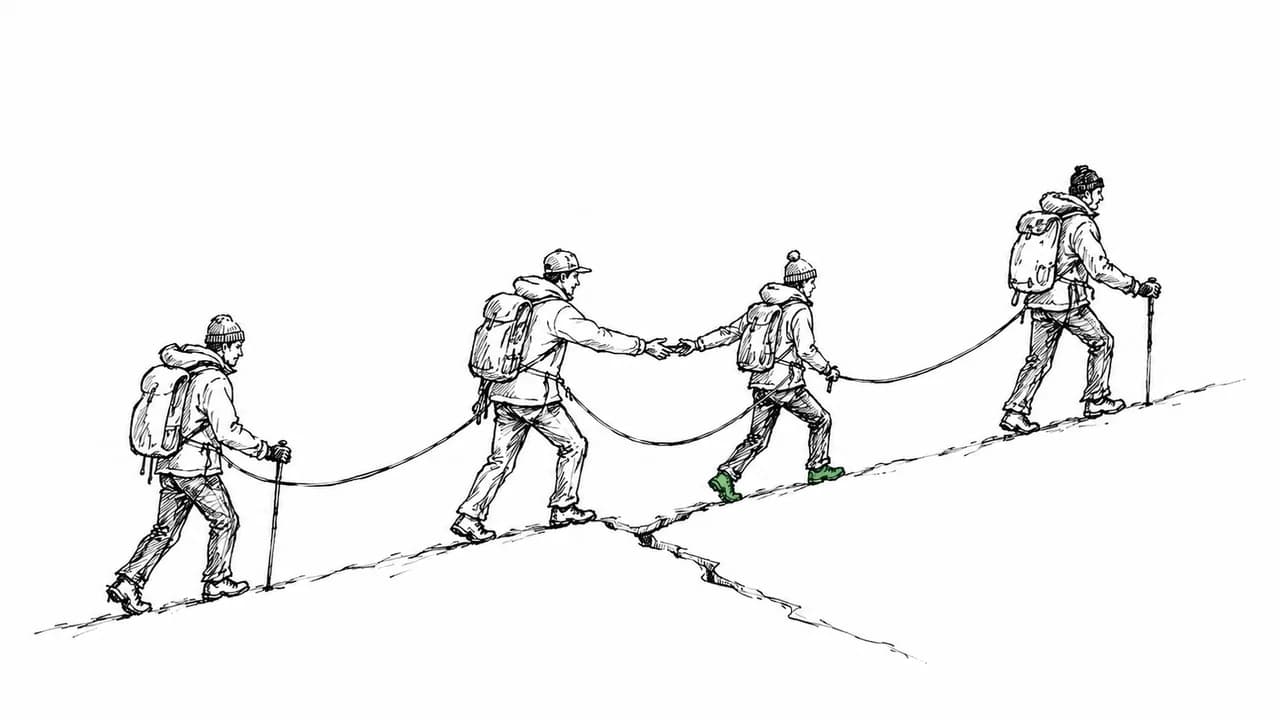
Product designer Rob Brogan taught himself design, worked his way to Amazon, and has had 0% success applying to a job with just a resume in 13 years. Laid off from a startup, he found the Never Search Alone framework and built two peer groups: a matched council of strangers and a daily standup with a former coworker. He talks through the mental grind of repeated interview rounds, and why the employer has to impress you too.
Key takeaways
- In thirteen or fourteen years he has had zero percent success applying to a job with just a resume: every role came through a recruiter or a personal connection.
- Find a peer group and run the search alongside other people; strangers are encouraged, and someone outside your discipline catches the jargon and acronyms you can no longer see.
- A fifteen-minute daily standup with a laid-off former colleague is mostly a mental health measure, because it gives the day structure and a reason to get up.
- Interview the employer too: an AI-written or bare-bones job description is a red flag, and asking the hiring manager to describe a day in the life tells you more than any culture page.
- Nobody reads, so put a couple of focus keywords after each job title on your LinkedIn profile rather than the bare title.
Chapters
- 00:00 From self-taught designer to Amazon
- 08:28 Why recruiters made the difference
- 12:56 Getting laid off and learning to Never Search Alone
- 19:18 Building a peer support system for the job search
- 23:06 Managing the mental grind of job hunting
- 27:31 Interviewing the employer, not just being interviewed
- 34:05 Managing leads, recruiter outreach, and staying visible
From self-taught designer to Amazon
Find some sort of support network. If it’s Never Search Alone, you don’t need a friend group. In fact, strangers are encouraged. Pair yourself up with a couple of other people and go through this process with someone else. A lot of people are getting laid off kind of en masse. So if maybe you have some former colleagues you could reach out to and have just kind of an informal standup. Having something that gives your day a little bit of routine, a little bit of structure, helps bring a sense of normalcy to this, because it can be tough kind of going out alone.
Welcome to the JobQuest podcast, where we treat the job search as a hero’s journey, and we’re talking with all kinds of job search heroes, as we like to call them. So, career coaches, recruiters, job seekers, some who found jobs, some who are on the job hunt. And I know you fall into that category. So I want to welcome product designer Rob Brogan to the show.
Thanks. Thanks for having me.
Yeah, it’s going to be a great conversation. Really excited to have you here. So just to kick things off, could you tell us about your own career journey and your own current JobQuest?
Yeah. Well, it’s kind of a winding path, I visualize it. I kind of come in the non-traditional route, although I hesitate to say there is a traditional route. I guess I would think someone who goes to college for design is more the traditional route going into a design job. But in reality, I almost feel like that’s the minority of all of my peers at some of the bigger agencies I’ve worked at. I did meet some people who have an MFA in art or design, but actually now we have a lot of people coming in through these boot camp courses, and then you have some self-taught folks. I guess I fall into that category.
I went to school for languages. I studied Spanish and psychology, so I was just fascinated with how people see the world and interact with it. And I’d always been kind of a big tech guy, but never thought of myself as a programmer or a coder, so I long kind of eschewed that path of computer science. Fast forward a few years though, and someone had told me about user experience design, which was this, I think of it as like a middle ground between the final visual result of the interface and the brand design that you would recognize on a web page, and then of course the deep background code and the engineering that goes into it. User experience is more of the strategy of how you can shape coming in the front door, or the homepage, and all the way through a checkout, if this is an e-commerce type of experience, or if it’s a media type of experience, how you find what you’re interested in watching. And I’ve always been really interested in that type of space.
So that’s kind of the earliest origin of someone just making me aware that this was a job at all. And back then I tried applying to a design school here in New York, SVA, for their masters, because I thought, okay, if I want this job I have to go back to school. They asked for my design portfolio and I said, you’re supposed to teach me design, I don’t have one. So I didn’t get into SVA. And kind of serendipitously, a friend of a friend had made some sort of connection at a conference, and they knew that I was interested in getting into this, and that person gave me an opportunity as a junior designer. My job title was information architect in my first job.
Okay.
And it’s also funny, I don’t know how much of a tangent you want to get off on this, but design job titles have changed, kind of every couple years they like to change it up. And information architecture kind of felt to be the esteemed version of user experience. Now, if there’s any actual designers listening to the show, those are different disciplines, but companies as we know will kind of put the job title regardless of what your actual tasks are. So I was an information architect mostly doing wireframes and content strategy for websites.
Okay.
Which is really kind of organizing what the company has to say about itself and where you can navigate and get its products. Then at another job after that, kind of the second agency. And agencies, by the way, are a great place in early career to get portfolio diversity, because you have multiple clients every few months. So you could say you’ve worked on a bank, an insurance company, a cruise liner, whatever type of company. You get a lot of that variety, and I found a lot of support from the senior managers at these agencies.
But the next job title after that was interaction designer, which also sounded pretty cool. Technically interaction design is kind of narrowly focused just on the movement and how, you know, when you press on a button what happens. You think of like in the phone app when you’re looking at photos, you can kind of pinch to zoom in your photo grid and it gets larger or smaller, and that’s an interaction design.
Okay.
Obviously you can’t spend your entire day job just doing that stuff. So once again, I was doing wireframes, content strategy, and some user experience flows, which just document how you navigate through the site or the app. And yeah, I think that was a really great foundation for me.
And after some more of that agency experience, I’d say that was probably all in all maybe four years or so, I got a job at Amazon, which the title there was UX designer, but I consider that sort of my first shift into product design. I think of product design as someone who is really essentially focused on one product and going through this iterative cycle of improving it, experimenting, you know, you’re checking the analytics, seeing how your design decision is performing and making necessary changes along the way.
Okay.
At an agency like where I was before, you might have one opportunity to do, you know, like an A/B test, but usually it’s a client with kind of a brief, and you create the one solution and hand it off to them. And you don’t get to cycle back so much. In product design, or just in-house design, you are on retainer there, so you get to work on that piece of the product over and over and really polish it, which as a designer was the most rewarding part for me.
Yeah. So that must have been pretty exciting to land at Amazon. I mean, in just a couple years you’re starting with no design experience and you’re trying to figure out how do I get into this field, and then you get some jobs and you’re working for agencies and you do a couple things. And then how did that feel, to land the Amazon gig?
Yeah, it was really great. I had a friend who was working at Amazon and I had hoped that he could kind of get me a connection in, and it didn’t work out at the time. And almost serendipitously, a few months later a recruiter reached out to me from Amazon. And you know, it’s just so funny thinking about how competitive it is to get in there. I’m not sure why they even bother reaching out to people, I’m sure they have lots of people applying. But maybe it just, they look at certain backgrounds, certain firms that you’re working at that might pique their interest.
I at the time was at this design company called Fjord. It was a studio, nice little boutique, well, little, it was international, but the New York office was a small kind of one-floor studio. Everyone’s listening to their Sonos kind of background music, very chill design environment. It got acquired by Accenture, which is this huge multinational consulting firm. So maybe there’s an aspect of that kind of picked up on the radar. But anyway, I was definitely excited to jump on that opportunity and go over to in-house.
Why recruiters made the difference
And so that came through a recruiter. So maybe that’s a good transition to talk about the role of recruiting in your career, because I know that’s been, as we talked a little bit before, that’s been really important for you. And I wonder, I think that’s probably true for a lot of folks in tech. I mean, a lot of jobs in general, it’s a competitive job market across the board. And so when you’ve got a thousand applicants for a job, a company can be well served to work with a recruiter who can give them vetted talent. And I know that’s been a strategy of yours, right? Can you talk about how recruiters have helped you in your career journey?
Yeah, for sure. You know, it’s kind of starting at the end almost. I recently was trying to hire a second designer at this startup I was with, and I remember I just put a post on LinkedIn, not even a job opening, and got 16 applicants in like 15 minutes. And then I had to take it down because it was going to take me a while to talk to those 16 people. And of course I would have to do all the vetting, I don’t know if any of them would be worth talking to. And so I can’t imagine a company hiring without a recruiter. But it seems like they do, or they have a mix of both, where they have kind of just inbound leads and then they hire a recruiter to sift through all those.
But there’s, I can’t speak too much for recruiters, but I know vaguely there’s sort of the retained search recruiter who has a few clients and they go and hunt the best candidates for that role. And then you have kind of the, I don’t know what you would call it, the full-time recruiter who works for the company, and they’re maybe doing more of that fielding of the application.
But to get back to your original question, I feel like when I look back on my different jobs, except for that very first one that was friend of a friend who gave me a chance, so grateful for that opportunity, after that it was always through recruiters that I got jobs. I definitely sent out applications in between jobs, a lot of applications, and tried a few different versions of my resume, but I only got traction when I spoke to a recruiter, and I’m really thankful for them.
I think that they do take the time to sort of set up this conversation, maybe a little bit like what we’re doing right now, tell you a bit about my background, and they also know what their client is looking for. And they probably do a little bit more of that storytelling work and pulling out the pieces of your experience that are relevant and that are going to pique the interest of the client. So maybe it has to do with how they pitch me as a candidate. Whereas when you’re on your own, you’ve just got this PDF, hopefully AI optimized or something, to get through the door. And then hopefully someone, no, no one reads anything. As a user experience designer, I’ve learned you’re lucky if they read the first couple sentences. So hopefully their eyes fall on a couple of bullet points that are promising and they want to have a phone call with you, right? And so I think the recruiter is just an actual human kind of advocate out there for you.
So yeah, at Fjord, that agency, there was a recruiter. And then at Amazon, that was an in-house recruiter that worked for Amazon. And then after that I worked at an education marketplace called Teachers Pay Teachers, and that was the same recruiter from Fjord, who worked for Fjord, sorry. And then after that, I guess this is an exception, I followed a friend to this startup after Teachers Pay Teachers.
Okay. Yeah. But still personal connection there, as opposed to just sending in a resume.
So basically I’ve had 0% success applying to a job with just a resume. Yeah, in my 13, 14 years.
Getting laid off and learning to Never Search Alone
Yeah. Well, I think a lot of people can relate to that. And that’s definitely a theme that has come up throughout my conversations on the podcast here, is networking is so important, and it’s the human connections that you make that are going to get you that job. So what you’re saying totally makes sense.
So fast forward to the present moment, you get laid off, right, at your current job, which a lot of people can relate to. Definitely in tech there’s been a lot of layoffs to go around. And so first thing you do is call up the recruiter. I mean, take us through that process.
Yeah. So the recruiter who got me two of my great jobs in the past, you know, reach out to her and kind of ask, do you have any clients that might be a good fit for me at this point? She knows me pretty well and my background. And no fault on either side, just didn’t have anything that lined up for what her clients needed at the moment.
But she is really great, always looking to help, and recommended this book, Never Search Alone, which kind of gave me this framework to help navigate this job search without a recruiter, and also not entirely alone. Because without a good recruiter connection you can kind of feel like you’re just swimming out there alone. But at the same time, you’re aware, you see all these posts on LinkedIn about the thousands of people laid off from Meta or Google or Amazon, and you’re not the only one looking, but it still feels like you’re the only one. So how can we kind of pull all of these resources and cool websites and spreadsheets together to make something useful?
Yeah. Well, and it feels like you’re in competition with all these people too, right? Like, oh my god, not only am I out here feeling alone, but now I know there’s all these other qualified people on the market as well. Right. So how did this book make you feel, like they encourage actual peer groups and connections, Slacks and things like that? So can you talk about what was useful in the Never Search Alone strategies?
Yeah. I think that the book, which I listened to a couple of times on Audible, it’s a pretty quick listen, and it covers a very kind of step-wise strategy to start broad by understanding who you are and what you bring to the table. So some introspection, and then giving you a framework to reach out to people that you’ve worked with in the past. And all of this is around kind of honing your definition, your story of who you’re going to pitch to for those job applications, and navigating through this process.
You could do it by yourself, you know, just read the book, but they really encourage having this social element and this peer group support. So after you read the book, or you could sign up whenever you want I guess, but for me I did this after I finished the book. phyl.org, just to give a little plug for them. It’s P-H-Y-L. And you can go and see about the book, download free resources. They have kind of this big PDF of, I forget what it’s called, like a just laid off checklist, things to do, including mental health care advice, and get a counselor, a therapist, or read some philosophy and all that stuff.
But then they also have this Google form which will match you up with people who may not have the exact same job. So for example, I haven’t talked to any designers, but people who are of a similar seniority. You know, I’ve been working for 13 plus years and I’m at kind of a very senior, but I’m not really in a management type of position. So they put me with other people who are in the product world or even in engineering type of roles that are at that similar level. And it almost helps. I think I like a little bit of both, to be honest. It’d be great to have a little bit more designer input, but I think there’s also something to be said of being paired up with strangers, and also people who are from a different discipline, in order to give you more of an objective look.
Again, it kind of comes back to the storytelling. And if you’re giving a pitch, you’re writing a little blurb at the top of a resume or the little synopsis on your LinkedIn, the book really encourages to take out any jargon, any words that you used internally at your company, or even acronyms that you might think are common like CRM or SEO, and just explain it to someone who has no idea what your job is about. And so having that kind of third-party outside industry feedback is pretty helpful for crafting that type of story.
Yeah. So are you doing actual calls with these people? What is the mechanism for communication? Is it just through the Slack? What does, how does that work?
You’ve got the Slack for the sort of asynchronous advice and one-off questions. But they really encourage you to choose a path. The book is also great for people who do have a job, kind of want to throw that out there in case there’s an assumption this is only for people who are actively laid off or looking for something right now. It’s also for career switchers as well.
So the first thing you do is you kind of choose what track you want. You have the currently employed slow schedule, I believe it’s every other week you would check in with your group and do one of those steps in the book, and then check back later. The active searcher, someone who wants to go as fast as possible, could meet twice a week. And so that’s what I did for a while. Now we’ve kind of.
A Zoom call.
Yeah, a Zoom call, Google Meet, whatever you want. It’s very kind of self-organizing. And after we went through all the steps in the book, I think maybe 10, is it 10 steps? I’m probably going to get this wrong, but check out the website. And after you go through all the different steps, you may not have as much momentum to meet twice a week. So we dialed it back to once a week. And so it’s more of an ongoing request for help opportunity and just checking in on how people are doing.
A big theme that’s reiterated throughout that book is being comfortable with asking for help, which I’m still trying to learn to grow on doing that, especially out publicly on places like LinkedIn. But I’m definitely comfortable asking my peer group for help.
Building a peer support system for the job search
You mentioned to me in a previous call that not only did you do the Never Search Alone peer groups, but you also organized your own peer group with a former coworker, that you said you guys had this stand-up meeting while you were working together. And then as you both found yourselves on the job market, you decided to just keep that going. Is that accurate?
Yeah, it’s kind of a force of habit almost. I worked with this product manager at Teachers Pay Teachers, and so we had a really great team and great energy and really good collaboration. It just felt like we were always on the same page about stuff. And after Teachers Pay Teachers got acquired, and anyone who’s been through an acquisition, I’ve been through a couple, it almost never keeps the culture. So the company culture inevitably changes. And I stuck around for a little bit just for the job security.
But ultimately I saw that the product manager I had worked with, he went to this startup, and I thought, you know what, more than anything for me the most important aspect in my day-to-day job is the people I work with. Because you can do all types of work anywhere, but you got to go in every day and work with someone. And so I followed him to this startup, and very fast-paced startup, worked together every day, having our standups and check-ins along the way, staying in sync on the work. And then it came to this abrupt halt when the co-founders decided to get rid of the whole product organization. So both of us, along with a few of the engineers, were laid off.
And it was kind of this convenient setup with that Never Search Alone mindset of having someone to navigate this with. I did decide to kind of keep a separate Never Search Alone group going through their website and pairing up on their Slack community. But I kept checking in with this product manager on a weekly, or sorry, daily basis. We had a daily standup, just a 15-minute time slot that we throw on the calendar. And honestly, it was a lot less structured than the book. We weren’t going through any steps, we were just checking in with each other.
And I think that’s mostly on the mental health side of things, of just having something in the morning to get out of bed and get on the computer and say, all right, what’s on your plan for today? What are you looking out for? Do you have any opportunities lined up? How can I help? Of course we did basic stuff like the resume feedback and LinkedIn advice, but really it was just kind of some encouragement, sharing what we saw on the landscape. Even though we’re looking for two different roles, we’re both in the same kind of tech bubble. So seeing what’s out there and sharing tools and websites that are helpful for like practicing your interview or shaping up the resume. It was kind of just a great ping pong.
Managing the mental grind of job hunting
Yeah, I bet. So it sounds like that was really helpful with the mental grind, which I can imagine would be the case. Because as you’re trying to do something alone, especially something as stressful as a job search, and oftentimes it can feel like, I’m just going to do these same things again, they didn’t work yesterday. Like, you have to just not think about that sort of negative self-talk and just keep thinking positively that it’s going to work eventually, so I need to keep on going through this process. So it sounds like that was really helpful. How else do you manage the mental grind of this process?
Yeah. I think for me the challenges are kind of like in two buckets. There’s the almost like doing the laundry of sending out the applications, and that’s just a little bit more of kind of a grind in the sense of just task management. You know, maybe I want to send out three or four a day, and I want to be kind of mindful of if this is a good fit for me. Maybe I’ll take time to kind of write a little bit of a cover letter. So that aspect can be draining.
And I think to counteract that, it’s important to always have fun and to just get some fresh air if you can. Just really basic stuff. I mean, I started baking bread. I was never successful during COVID for some reason, I couldn’t get it to rise, and I thought, you know what, I’m going to try again. And so started making some nice rosemary focaccia bread.
Sounds good.
Walking around my neighborhood, I really like where I am in Brooklyn, and spending time with my wife of course, and just disconnecting.
The other bucket I feel like is a little bit more challenging, although you still kind of solve it with the same type of things, is the actual interviews themselves. So when you do get that hook and you have the conversation, and at least with tech interviews there’s usually four or five rounds, and I’ve had several cases where maybe I’ll get to the three out of five, and you’ve kind of talked about yourself and then you have another meeting where you kind of talk about all of your past work. And I would just, I don’t know how it is for other types of roles. I know like engineering job applications, they have a lot of tests.
Yeah.
For like coding. But for me it just feels like it’s justifying that you do know how to design and that you are a good designer. And there’s this sense of doing it over and over again, it becomes very draining, and when it doesn’t lead to success it leads to a lot of self-doubt of, am I a good designer, do I know what I’m doing?
And I don’t know how this is for other fields, but I just kind of compare this to my wife, who’s a physician, and she just got a job here lined up, and her process took about a month from application to offer. And I mean obviously physicians are in higher demand, but also I remember in her interviews, and just the resume in general, it’s a little bit less focused on do you know how to be a doctor, and it’s more, where do you want to work, what type of patients do you want to help treat, what kind of population are you interested in. And it’s more, I would, if I’m thinking about product design, it’s more like what are your goals.
And on the other hand, at least in tech, there’s no certification, there’s no license, there’s no even ground that everyone’s playing in. So now you have a thousand people applying to a job, and you have to have every person that you want to have an interview with explain that they do know how to do the job. I wish we could just kind of skip that step and just go to the company fit. That’s just getting a little bit off my chest, kind of going off on a tangent. But I think that coming back to your friends, people who know you well, and just hearing a little bit of that reassurance that, yeah, you actually, you’ve had several jobs, you do know what you’re doing, it’s just a tough market.
Interviewing the employer, not just being interviewed
It’s highly competitive. And it’s nothing personal, but it can feel personal after a while, as job seekers there’s obviously pressure to get the job and you feel like you want to impress the employer and all that. But the employer’s also got to impress you. And I think that’s an important thing that job seekers often forget, right? It’s like, okay, just any job is not necessarily what is going to be best for me. I also need to find a job where I’m going to actually be happy, where I’m going to like the work and like the people that I’m working with and like the culture. So what sorts of things are you interviewing employers for? How are you vetting the types of people and the types of places that you’re looking to work at?
Yeah, I mean, I think to a small degree it even starts on the job description. I’ve had some job descriptions that are written by AI, which I kind of just consider to be a red flag. You only have to write it once and then a thousand people will apply, so put a little more effort into it and tell me about your company. So I kind of steer away from things that are a little bit robotic.
Also things that seem just, I don’t know how to describe it, bare bones, just kind of focused on the crucial pieces of the job. You know, when they talk about the role requires, and then they have those bullet points of five years of experience doing user experience, expertise in insert software name. That’s definitely fine if it’s accompanied with other things, like interest in mentoring other colleagues, or maybe it’s highly collaborative, involving external stakeholders, or something that, it can be businessy, but it still hints at how you connect with other people at the company. If it doesn’t have that and it’s just kind of the skeleton of, yeah, that’s the definition of a design job, you haven’t told me anything about what this job is. I feel like that’s something that I avoid as just not interesting.
And then things that attract me are the mission-driven type of company. Every company I’m sure has a mission, but it’s how you communicate that, how much you care about it. Because I think that also from a designer point of view, you have this process of iterating and trying new things to see what works, and if you apply that to a company, a company with a mission means you have this kind of guiding light or direction to go, and you can take a little bit of a zigzag path to get there. I think without a clear mission or an aspiration, you might fall into this trap of a leader who wants a specific thing. I want this product, I want it to look like this, or I want it to do this. And you can build that, but then what? Where do you go from there? And it can be a little chaotic, maybe you quickly change direction. And so anyway, that’s just kind of another cue of something that I feel is something I would want to avoid, is a lack of a mission or kind of a guiding north star to what the company’s all about.
Really the most important part to me is the people I work with, and that’s impossible to tell from the job description, or a little bit on that culture page on the about us, you know, pictures of people playing croquet or something or having ice cream. I think that’s nice, but it can also be performative, so you’re not sure how real it is. I think you just have to wait for the initial couple of rounds of interviews. Hearing how, on that screener call, how they describe the company and the changes over the last maybe six months.
Mhm.
But then for me the clincher is really talking to the hiring manager, which is usually after that first screener call.
Okay.
And I always ask them about the team. You know, tell me about, who would I be working with? Am I going to be working with some other designers there? Maybe it’s a small company, I’m the only designer. Who would I be collaborating with on a day-to-day basis? And what’s that kind of rhythm look like? I try to get them to describe a little bit of day in the life. And that helps me get a sense of where I would like to be.
And what are you listening for when they’re describing that day in the life?
Something that is collaborative. And I feel like collaborative is kind of a cliche or overused term, especially in design, but people who really like to come at a problem together, and not sort of, okay, I own this part and you own that part and you kind of stay in your lane. But people who are okay just sort of blurring the lines a little bit and seeing how they can all work together towards that one goal or challenge.
I don’t really know what a perfect answer would be, but I think I really like team structures that have this product trio model. I think Marty Cagan might have been the first product guy to talk about that. I don’t necessarily know the origin of it.
Okay.
But it’s a team that’s built on this collaboration between the product manager, product designer, and an engineering lead. And so even though you could have a broader team of various individual contributors, I would be part of that little tripod structure that’s involved on all the decisions.
Amazon, for example, as great as it is on the resume, was a little bit more of a top-down structure. The product manager would come to our little design group with a fully detailed PRD, which is a product requirement document, saying this is exactly what needs to go into the page and how the feature needs to work, and it would leave a little room for the imagination, which as a designer of course you want a little bit of imagination room to kind of experiment with ideas, right? So that’s an example where I was never collaborating with a product manager at Amazon, it was just kind of like, here you go, get started. And then likewise, I feel bad, we did the same thing to the engineer, here’s the design, it’s all done, you can go build that. Whereas most of the other companies it’s a lot more, hey, we’re all working on this for this month, and we kind of share our updates along the way.
Okay. So you’ve got that background and that experience in different environments, so based on what somebody’s telling you, it kind of matches up in your brain, like, oh, that sounds more like that Amazon experience which I didn’t necessarily love, or it sounds more like that startup experience which maybe was more the kind of style that I want to work in.
Exactly. That’s a great way to summarize, is just kind of drawing on my experience of getting a feel of, what does the team structure look like? What’s the product kind of plan, how does that unfold at that company, and does it look and feel like the jobs I’ve enjoyed or the jobs that I hadn’t enjoyed as much?
Managing leads, recruiter outreach, and staying visible
Right. Yeah. So you’ve got some leads now, I understand, that’s exciting. What’s your strategy for managing leads, and what are your kind of expectations and prospects looking like, if you don’t mind sharing?
Yeah, for sure. I definitely heavily used LinkedIn. I am a bit frustrated with the actual functionality of finding jobs on there.
I will say that could be a whole other podcast episode, if you want to critique the design of LinkedIn.
But as far as inbound, I get a lot of recruiter messages through there. I will say, just throwing out kind of a hot tip, with the way I did my LinkedIn, I had just the job title, usually like I would have on a resume, UX designer, product designer, lead product designer, all the way up. And I started doing a little dot, and this is not groundbreaking, I’ve seen other people do it, where you throw in a little dot or a hyphen and you put in one or two words of what was the focus at that company. So, you know, Teachers Pay Teachers, I did a lot of work on the seller side of this marketplace, so I’ll say like marketplace seller experience. Or at this startup that I was at more recently it was all about growth and new user onboarding, so I’ll say product design lead, growth onboarding acquisition. And like I said a while back, nobody reads, and that’s just human. So if you have a couple keywords up there in the title, I think that catches their attention.
And I’ve noticed, kind of coming back to the inbound stuff, a lot of recruiters are reaching out to me about their growth opportunities at startup or medium-sized companies. We want someone to help the acquisition kind of top of funnel for our product. And this is something that I learned through my peer group with Never Search Alone, about looking back on my experience, that I happen to have a lot of experience on marketplaces. That’s not where my heart is per se, but right now it’s this sort of packaging yourself as, this is where a lot of your experience lies, so target that type of job for the near term.
And I manage those basically by just saying yes to everything, even if I’m doubtful. Or sometimes it’ll be a six-month contract job, which I don’t think is usually a good fit, I’m looking for full-time or maybe a really short-term kind of contract. But introduce yourself, always take the call, give them your story, and you never know. I’ve had plenty of recruiters, it doesn’t work out for that job, but they’ll come back a couple weeks later with something else. You’re in their system and hopefully on their mind. And then I have once in a while kind of just a cold email will come in, I’m guessing that’s also through LinkedIn but they just choose to do an email, and I always reply to those. So I think that those quickly turn into a calendar invite. So the short answer to your question is calendar invites. I have my calendar kind of booked out for the recruiters that reach out to me.
And then on the outbound, when I’m applying to jobs, I’ll often use a form filler tool. Importantly, not writing anything for me in terms of crafting a description. It’s just filling in the rudimentary name, do you need a visa to work in this country type of questions. And then when the dreaded Workday form.
Exactly.
So when you use this Chrome plugin that fills that in for you, after you hit submit it saves that URL that it filled for you. So you can also go to that plugin’s website and see a dashboard of all the places that you have previously filled out forms on. So I don’t have to do that work of keeping track of where I’ve applied to places.
Yeah. Do you have, as we’re coming to the end of time here, do you have a, and this is a spur-of-the-moment question, but do you have like a top tip for other job seekers who might be in a similar boat as you are?
I feel like I can’t think of a single top tip. Well, I guess the most important one for me is find some sort of support network. If it’s Never Search Alone, you don’t need a friend group. In fact, strangers are encouraged. Pair yourself up with a couple of other people and go through this process with someone else. A lot of people are getting laid off kind of en masse. So if maybe you have some former colleagues you could reach out to and have just kind of an informal standup. I’ve really enjoyed that. But having something that gives your day a little bit of routine, a little bit of structure, helps bring a sense of normalcy to this. Because it can be tough kind of going out alone.
Awesome. I think that’s a great note to end on. So Rob Brogan, I wish you luck in your JobQuest, your job search, and thank you so much for sharing your insights with us.
Yeah, thanks so much.